

Rare Roman Terracotta Head Discovered at Magna Fort, Hadrian’s Wall
News: Released 4th February 2026
Now on display at the Roman Army Museum
Archaeologists and volunteers excavating at Magna Roman Fort (Carvoran) have uncovered a rare terracotta head in the 3rd century AD ditch fill, shedding new light on religious practice and local craft on Rome’s northern frontier. The discovery was made as part of a major five-year project funded with support from The National Lottery Heritage Fund.
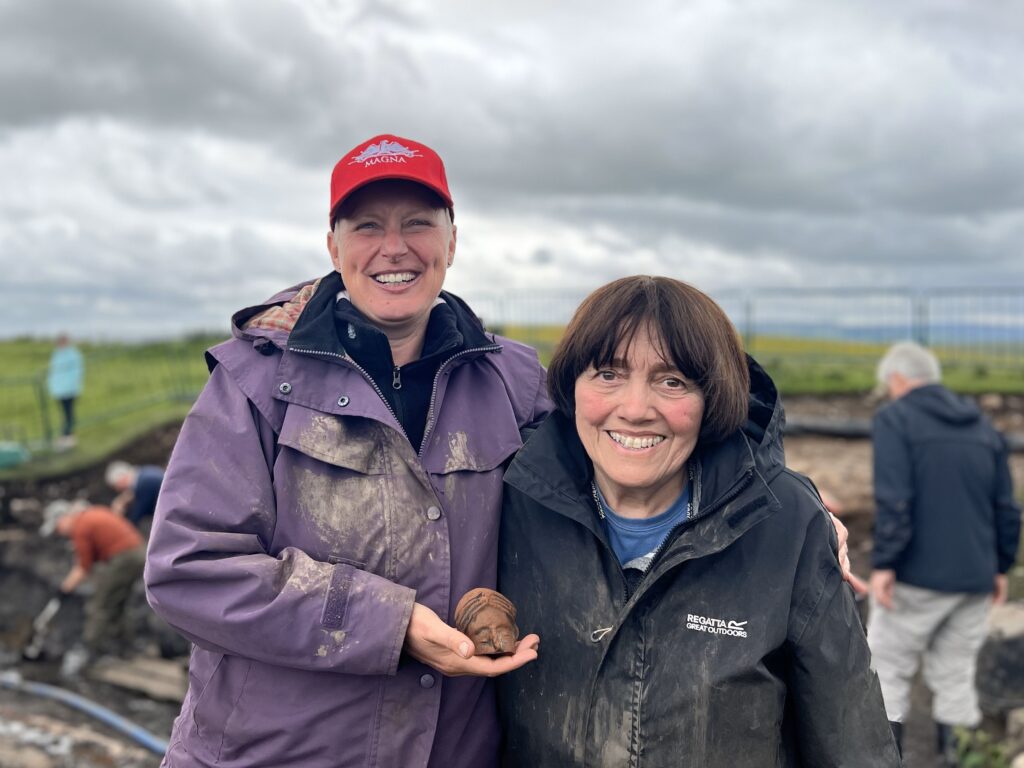
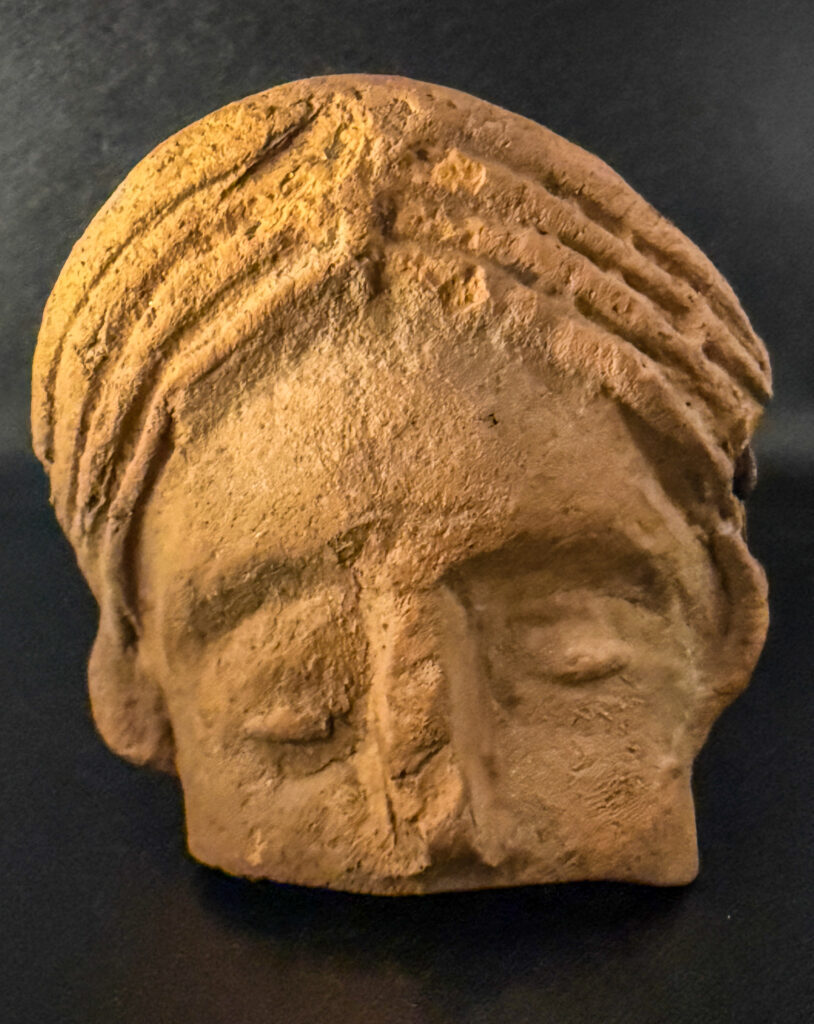
The terracotta head was found on 5 June 2025 during excavations of the fort’s northern defences by volunteers Rinske de Kok and Hilda Gribbin. Measuring 78 mm by 67 mm, the orange terracotta head depicts a female figure with a centrally parted, four-strand plaited hairstyle. The piece is broken below the nose and appears crudely made, with notably asymmetrical eyes.
Roman artefact specialist Lindsay Allason-Jones commented:
“It appears to me that this has been a practice piece by an inexpert hand… the eyes do not match at all, and the ears are very weird. That leads me to presume it was made on site as no-one would have bothered to transport this very far or paid good money for it!”
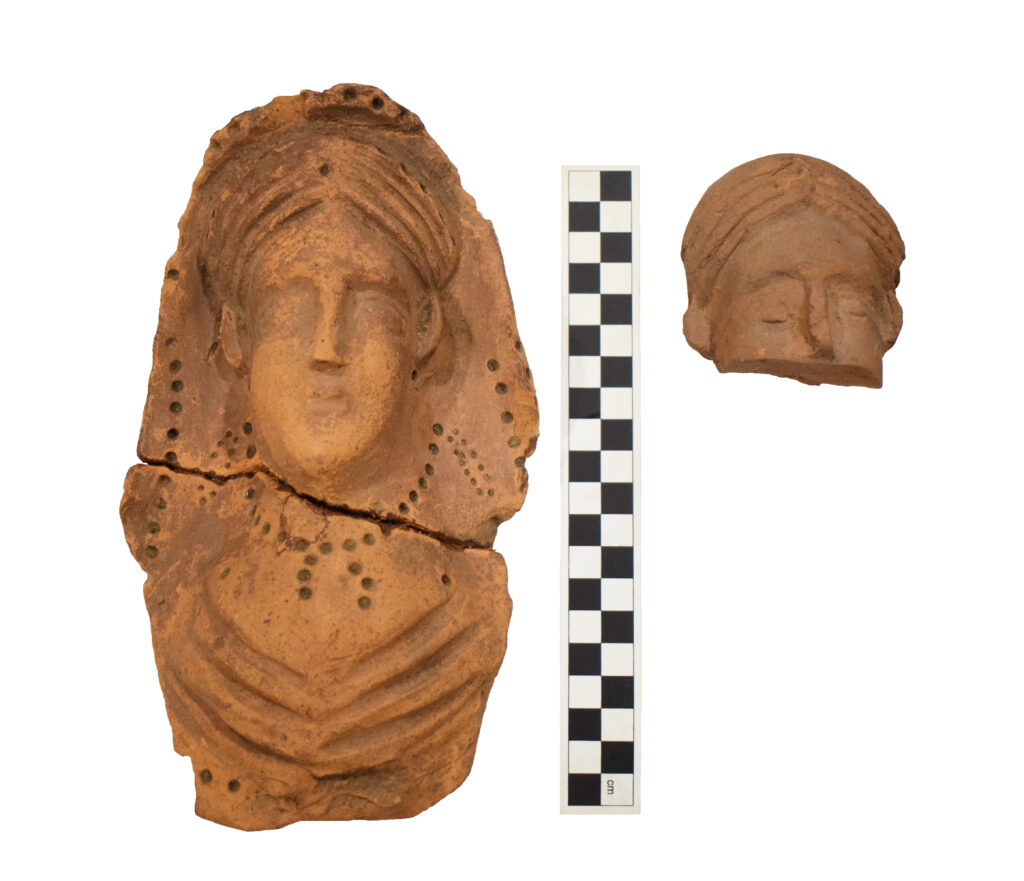
Lindsay noted that while terracotta face pots are common in Roman Britain, free-standing heads are rare, and recalled a second, more accomplished terracotta head found at the Magna site in the 19th century.
That earlier example, donated to the Society of Antiquaries of Newcastle upon Tyne in 1982, and now held in the Great North Museum: Hancock, preserves a fuller head and bust and shares striking similarities with the new find, including the distinctive hairstyle and facial features.
Rachel Frame, Senior Archaeologist at Magna, said:
“There are clear similarities between the two heads from Magna, they are clearly meant to depict the same figure.” She added, “My current hypothesis is that the 2025 find is a locally made copy of the earlier example, which may itself have been imported. The woman depicted was clearly important to the people living at Magna.”
Terracotta busts such as these are widely interpreted as votive objects, used in religious contexts. While common elsewhere in the Roman world, they are unusual finds in Britain.
In addition to its Roman biography, the earlier head has a remarkable post-Roman history. First published in 1889 in Archaeologia Aeliana, it was then in the possession of Miss Mary Ann Henderson of Haltwhistle, the last member of the Carrick family to live at Carvoran farm. Henderson likely found the object while living at Carvoran in the late 19th century and appears to have kept it after selling the farm in 1885. It may have remained in family hands for nearly a century before being donated to the Society of Antiquaries in 1982.
Malavika Anderson, Museum Manager at the Great North Museum: Hancock said:
“It was wonderful to see this newly uncovered terracotta head from Magna. Linking it to an artefact held in our stores demonstrates the importance of safeguarding collections for future research and the new stories they can still reveal.”
The identity of the woman remains unknown, though possibilities include an imperial figure or a goddess. Researchers are now inviting further comparisons from across the Roman world.
Barbara Birley, The Vindolanda Trust’s Curator commented:
“The newly discovered terracotta head will go on display at the Roman Army Museum as part of a recent finds display along with some of the other highlights of the project so far. These include leather shoes, a silver ring, bone hairpins, glass beads and a Venus pipe clay figurine.
Barbara went on to say:
“We are grateful to have the support from The National Lottery Heritage Fund, made possible by National Lottery players, who have enabled the Magna project to be realised and shared with the wider public – there is still so much more to discover about the people who lived at this Roman fort and we look forward to seeing what else is uncovered in the last two years of the project.”
Helen Featherstone, Director, England, North at The National Lottery Heritage Fund, said: “It’s incredibly exciting that the team at Magna have uncovered this rare find during one of their excavations. This discovery builds on our understanding of the Roman heritage of the area and it’s fantastic news that this find will go on display to spark curiosity and inspiration for visitors to the site. The project has been made possible thanks to money raised by National Lottery players, and I’m sure that many of them will be thrilled to know that they’ve played a role in this discovery.”
All images © The Vindolanda Trust
ENDS
About the Magna Project
Magna, a unique Roman fort on Hadrian’s Wall, under the care of the Vindolanda Trust, holds some of the keys to understanding the biggest questions about the people of the Roman frontier. Magna has it all and includes half a milecastle, part of Hadrian’s Wall, the Vallum ditch, a large town, rubbish dumps and pits, cemeteries and the fort itself. It’s the junction point between three Roman roads, the Military Way, the Stanegate and the Maiden Way. The site covers an area larger than Vindolanda and has the same preservation layers of organic remains and it is now under threat from climate change.
The Magna project is a five-year research project which commenced in 2023. It will examine three areas of the site, from north to south, building up a profile of the way the land has been used from ancient to modern times. It combines archaeological investigation with non-intrusive survey, and it builds and improves on the previous geoarchaeological investigation work that has taken place. The legacy of the project will be an informed management plan for Magna which provides the Vindolanda Trust with the knowledge that it requires to help preserve this irreplaceable landscape for years to come.
www.romanarmymuseum.com / www.vindolanda.com
Follow @VindolandaTrust on Facebook / Instagram and YouTube
About The National Lottery Heritage Fund
Our vision is for heritage to be valued, cared for and sustained for everyone, now and in the future. That’s why as the largest funder for the UK’s heritage we are dedicated to supporting projects that connect people and communities to heritage, as set out in our strategic plan, Heritage 2033. Heritage can be anything from the past that people value and want to pass on to future generations. We believe in the power of heritage to ignite the imagination, offer joy and inspiration, and to build pride in place and connection to the past.
Over the next 10 years, we aim to invest £3.6billion raised for good causes by National Lottery players to make a decisive difference for people, places and communities.
Follow @HeritageFundUK on Twitter/X, Facebook and Instagram and use #NationalLottery #HeritageFund