

Marcus the Medicus
3 minutes reading time.
Did you know that there were doctors, or medicus, in the Roman Army? A writing tablet from Vindolanda (Tab. Vindol. 156) mentions Marcus, a medical orderly. No evidence, as of yet, has been discovered at Magna Roman Fort for a medicus. It is likely there was a medicus here at Magna, due to the size and length of occupation of the Fort, from pre-Hadrianic to post-Roman, and so we will have to see what is uncovered by the archaeological team during the excavations.
Some of the duties of a Roman medicus would include performing surgery, treating dental abscesses, and treating eye diseases. We have evidence from across the Roman Empire of how this was done, and our Marcus (or to give him his full name Marcus Pergamus Iustus) will lead you on an exploration of Roman medicine through a series of short videos.
In modern life Marcus is otherwise known as Dr Andrew Newton, who is a retired NHS Emergency Medicine Consultant. Combining the clinical experience of a lifetime of medical practice (including managing battle-field trauma whilst on active service) with a fascination for the history of medicine allows ‘Andrew’ to bring some fascinating insights into the life and times of ‘Marcus’. Andrew is a member of the Roman Military Research Society.
Roman Surgery
Surgery was part of Roman medical practice. We know this because archaeologists found surgical kits in cities like Pompeii. The tools found in the House of the Surgeon in the ancient Roman city of Pompeii included forceps, scalpels, probes, and other tools that suggest the Roman’s had relatively advanced medical knowledge and surgical practices.
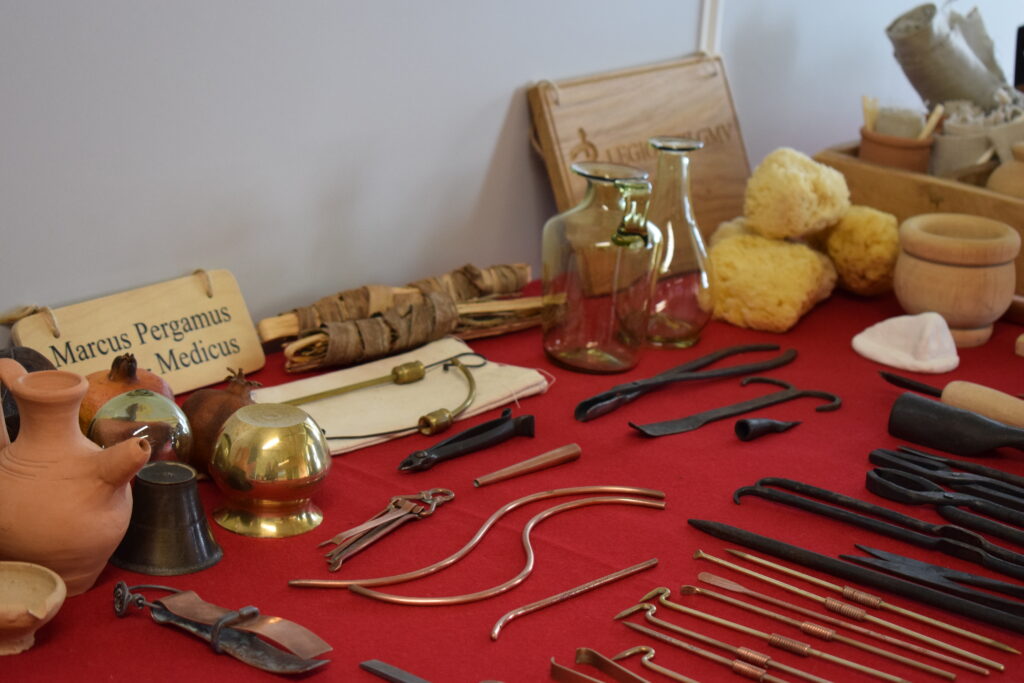
On display at the Roman Army Museum, tweezers, probes, spatulae (broad-bladed instruments), and ligulae (tongue-shaped instruments) showcase the variety of tools that were used by medical orderlies or military surgeons. Download this Roman Surgery worksheet to connect the tool with their possible uses.
Watch the video below of Marcus the medicus discussing Roman Surgery. What do you notice about the tools the medic uses? How might surgery in Roman times have been different from today?
Roman Eye Diseases
Romans were aware of eye diseases and have even described operations for cataracts in their medical texts. Download this worksheet to learn more about Roman Eye Care and complete a wordsearch all about Roman eye care.
The Strength Report writing tablet from Vindolanda Roman Fort (Tab. Vindol. 154) tells us that of around 752 men, 10 are suffering from “inflammation of the eyes”. Watch the video below of Marcus the medicus discussing how the Romans would have treated eye diseases.
How did Romans try to help with eye problems? Why do you think eye care was important in the Roman Army?
Roman Teeth
It is hard to tell from evidence whether there were dentists in the Roman Empire. Archaeological evidence of some tools that could have been used for dental extraction, however, there is no actual extraction evidence demonstrated. In the evidence from Popmeii, for example, no dental forceps were identified. However, we do know that the Romans did take some care of their teeth – they even had toothbrushes and toothpaste!
Watch the video below of Marcus the medicus discussing how the Romans looked after their teeth. What is similar to how we clean our teeth today?
The Vindolanda Trust has a number of Roman Medicine activity sheets to download, including Roman Plants and Medicine and Romans and the Evil Eye where you can learn more about the herbal remedies to sickness and disease, as well as the superstitious and symbolic ways you could protect yourself.