

Period 4
Here we will post regular updates on the current excavations and post excavation taking place on site here at Magna Roman Fort during Period 4 of the 2026 excavation season.
You will hear from our archaeologists and volunteers as they share news and thoughts about what is being uncovered, the challenges and the highlights of the excavation season.
18th May
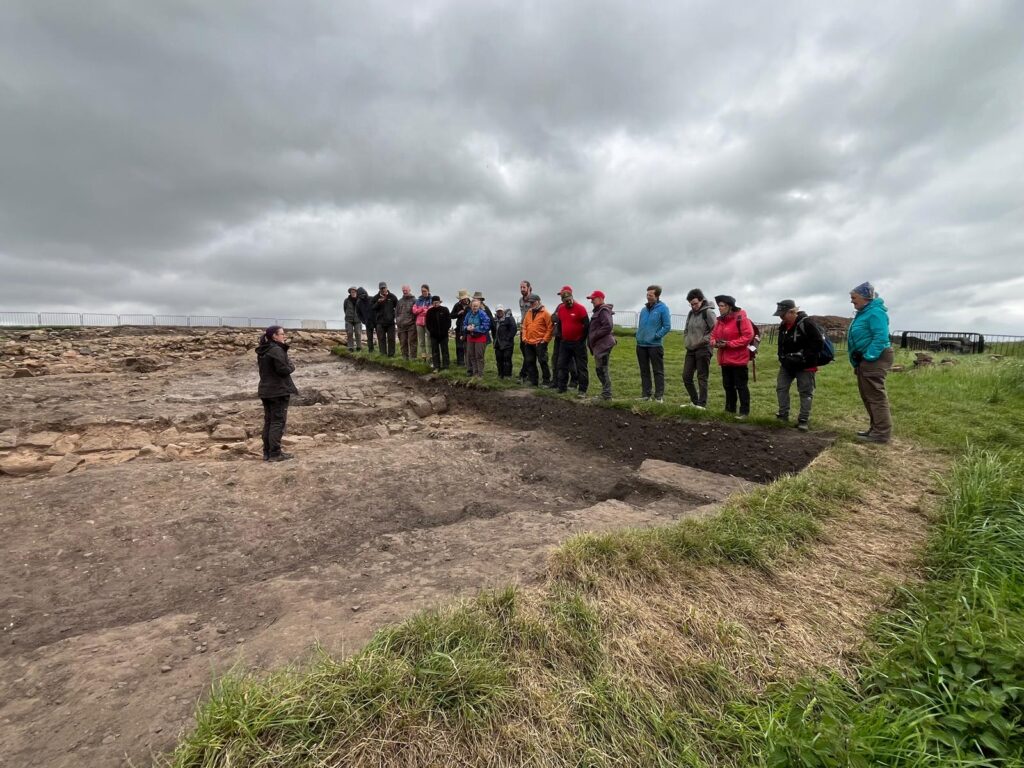
And we’re back! Period 4 is officially underway as we kicked things off this morning welcoming our new crew with a great mix of returning faces and new volunteers.
We started with introductions before Rachel led the group on a site tour, walking everyone through the key areas of the trench and picking up from where Period 3 left off. With so much having been uncovered over the past few weeks, there was plenty to take in, from the praetorium and expanding the trench northwards over antiquarian backfill to the southern ditch.
The team then got straight to work, continuing in that southern ditch and along the northern edge of the antiquarian trench, ready for further exploration as the week unfolds.
We’re also delighted to be joined again by our post-excavation team, who are already hard at work in the Magna archaeology centre processing bulk finds, pottery, animal bone, and glass, alongside the soil samples from the trenches.
With the southern ditch and the praetorium both high on our agenda this period, we’ll see if the ground has a few more surprises, or mysteries, in store! Sophie
20th May
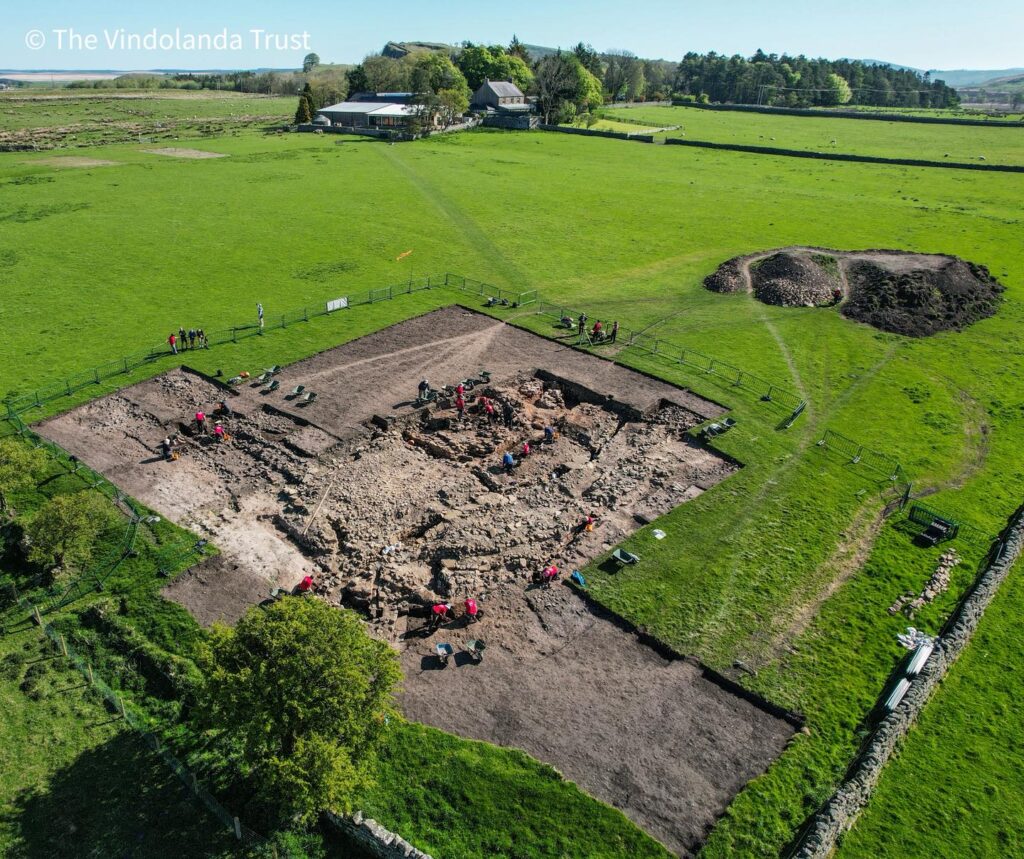
Besides our drone shots being wonderful pictures and indicators of just how much soil each period shifts during their two weeks on site, these images are very important for our post-excavation work as archaeologists. In many modern archaeological excavations, drone technology is utilized as opposed than the traditional hand-drawings. Hand-drawings are still very useful at a small scale, but our trench is well over 800 square meters – it would take even a skilled archaeological illustrator weeks to map out a plan of our site, and this would need to happen at each significant layer of occupation as well.
Luckily, modern drone technology and geographic information system software such as QGIS allows us to take these images and geo-reference them all within an afternoon. Features are still mapped by hand, but in a computer program rather than a pencil and paper. These drone images allow us to create maps that are within 1-3cm of accuracy – about the same level of accuracy if we were mapping out each stone using a GPS. Within these maps, we can turn on or off different layers, allowing us to view all Iron Age features at once, all 3rd and 4th century features at once, and so on. We can also produce geospatial statistics using finds or samples which lets us do more in-depth research about the fort.
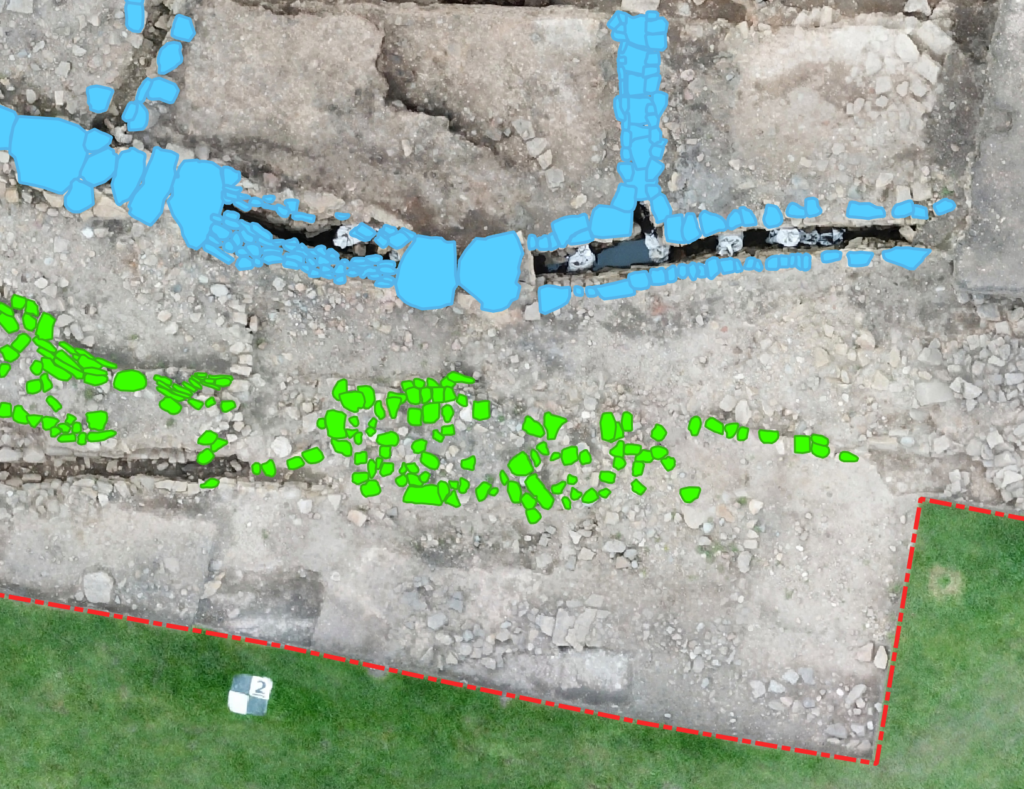
Readers will find cleaned up version of our maps in our yearly interim report. Creating these maps, and keeping them up-to-date, is just one of the many tasks you might find us archaeologists doing during the wintertime when we’re off season or during a rainy afternoon. Franki
22nd May
The start of a new period has meant that the time honoured tradition of clearing topsoil has continued across the site, opening up new areas of archaeology for the team to investigate.
In the praetorium area we have stayed north of the antiquarian excavations, investigating the undisturbed part of the building and seeing what survives. So far the volunteers have uncovered sections of floor that was most likely the internal courtyard, though there are some intriguing holes in this surface that may be large pits or other features dug through the ancient surface. As they move further north, I am hoping we will locate the wall of the northern range of the praetorium and start defining some of the rooms within it. We know the south range of the building was the location of the private baths, but have no sign yet of how the rest of the house was arranged, so I can’t wait to see what we get!
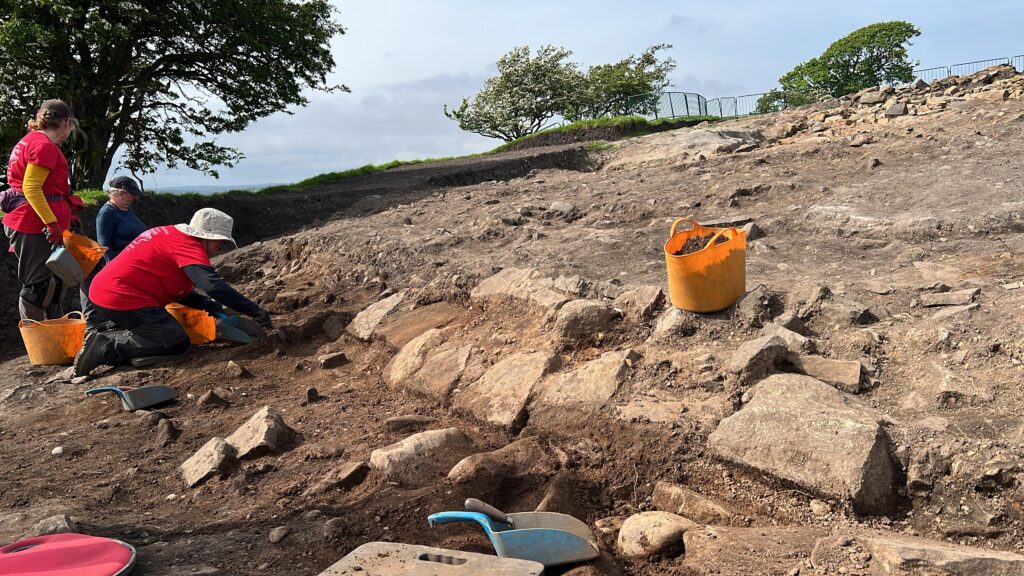
Over on the south side of the trench the group have put in a great effort removing a big amount of the colluvial hillwash spread over the area, getting us ever closer to the archaeological fills of the south ditch. They’ve also been working on defining the features of the earlier stone fort wall, cleaning off the inner turf rampart to show the cut for the wall and the angle tower as well as uncovering more of the outer face of the wall and the bank in front of it. This hopefully means that next week we will be primed and ready to start excavating the ditch in earnest and reaching the anaerobic fills with all the organic remains they hold. Rachel
25th May
It’s the beginning of my second ever week of archaeology and the Magna dig has been truly incredible.
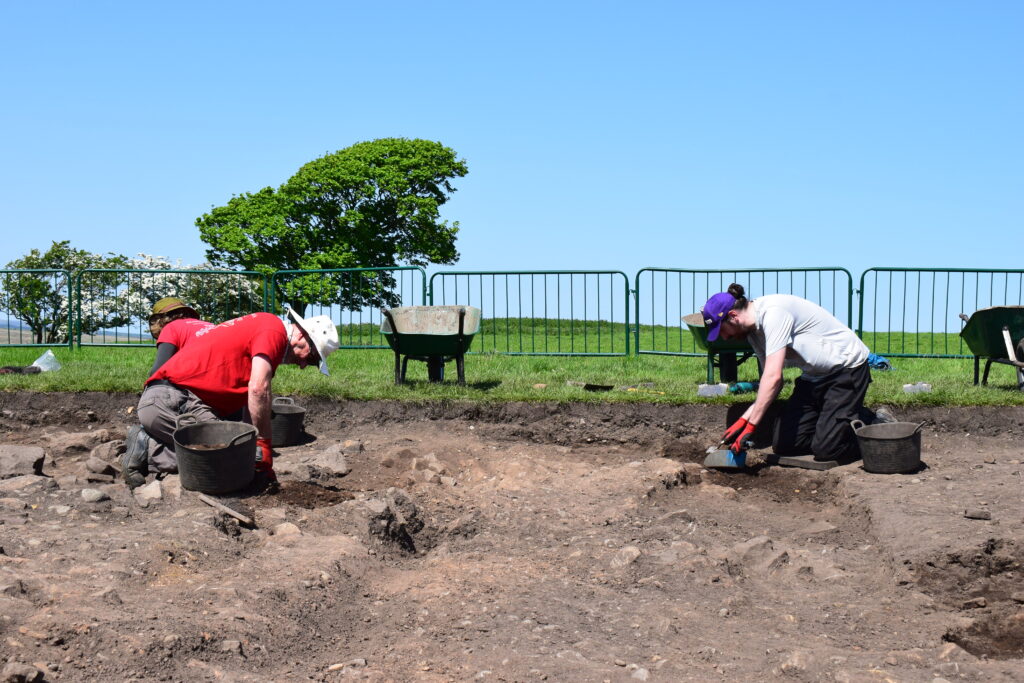
I must admit I was quietly terrified I was about to be let into the site and immediately break some ancient treasure but I shouldn’t hade been worried. Rachel, Tommy and the other experienced diggers got me up to speed quickly and I was soon in the muck digging away with the rest! I now know what a mattock is, how to trowel and what things to be on the look out for in all the soil.
I’ve spent the first couple of days with shovel in hand digging down to try and find the praetorium courtyard, getting a great workout as we did. The deeper we’ve got, I keep learning more about the site and how it never seems to throw what’s expected at us. Just because Rachel tells you to look for a stone floor, doesn’t mean you’ll find one and you’ve always got to be thinking and watching what’s happening around you on a grand scale, even as you look for the small finds.
Everyone said as soon as I find my first thing hidden in the dirt, I’d be hooked on archeology. And as everyone around me found old rusted nails and fragments of pottery I was again paranoid I was the newbie missing everything.
But then I found a tiny fragment of burnt animal bone. Then a nail. Then my own tiny bit of an old pot rim. It might not be some grand treasure, or the praetorium courtyard (yet!) but it all adds to what we know about the site and those who lived here. To me that pot rim was as exciting as any chest of pirate treasure I used to dream of as a kid.
I’ve definitely got the bug for archaeology now. So bring on next week, and I’ll be back next year just like all the others who’ve been here digging year after year! Neil Volunteer
27th May
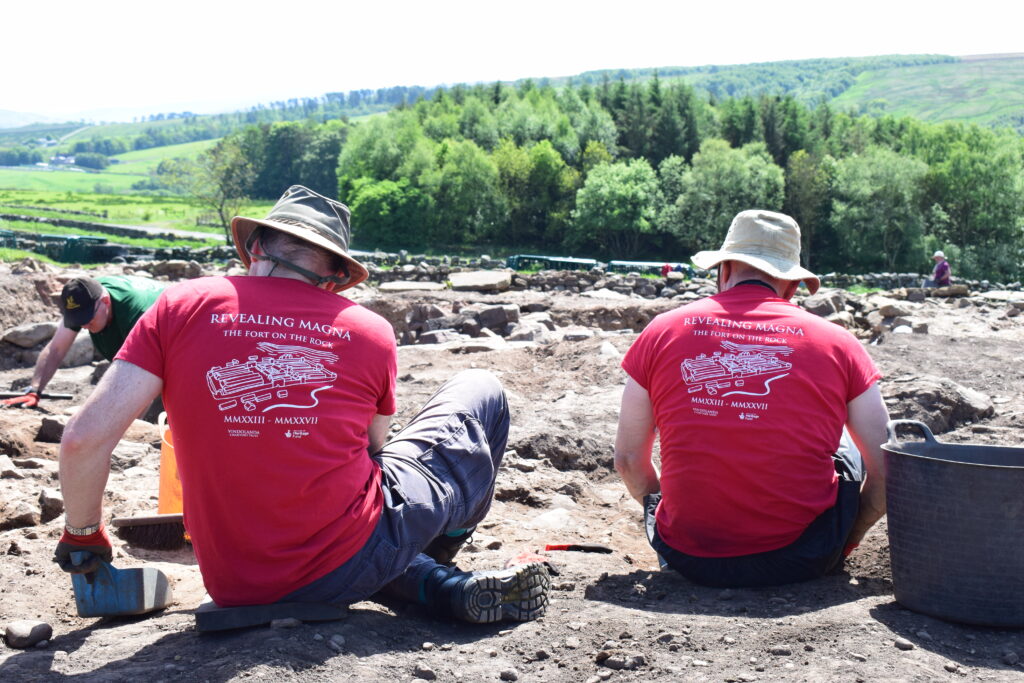
We have a fantastic crew of volunteers from both down the road and across the globe in Period 4, who have wasted absolutely no time getting straight into the trenches. Early in the period, the northern team successfully hit the rich Roman layers of the Praetorium courtyard, while the southern team finally located the edge of the wall ditch, happily tracing its path as it curves northwards. Amidst the usual steady stream of pottery and animal bone, we also unearthed a truly peculiar wrapped spool of lead, and we are incredibly excited to see if it holds any hidden inscriptions once it hits the conservation lab. We also found a very small but intriguing iron spatula!
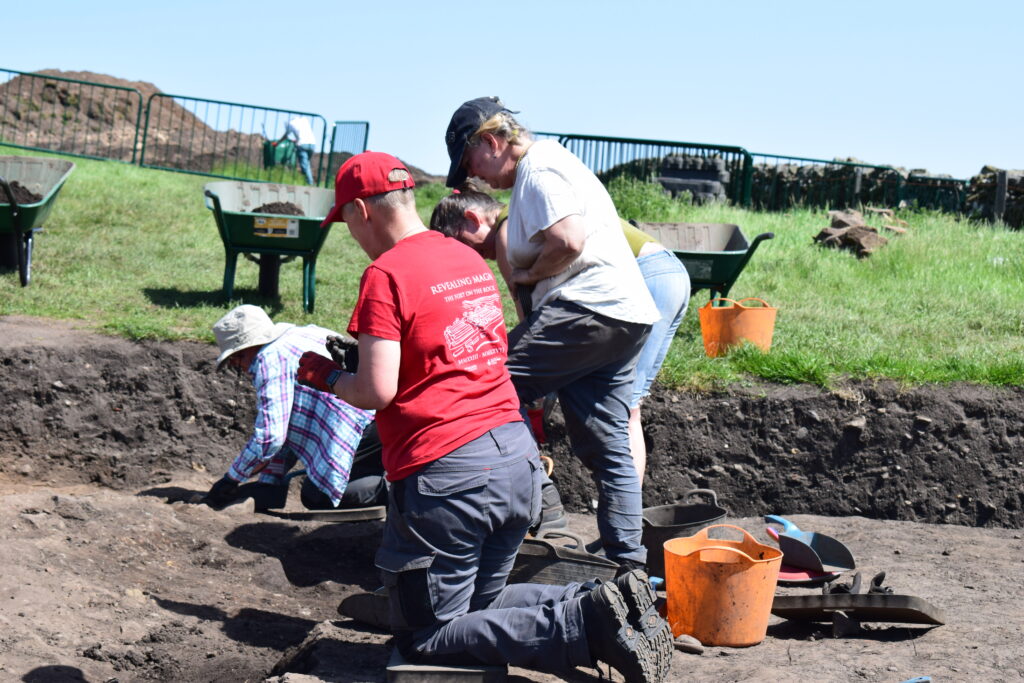
Heavy downpours last Thursday forced us out of the dirt, but it gave our resilient volunteers a brilliant chance to brave the weather and visit our nearby sister site, Vindolanda. Thankfully, Friday wrapped up the week on a high note with glorious blue skies which has continued into this second week! The teams are taking full advantage of the sunshine, carefully trowelling back the southern rampart to reveal more of the excellent wall.
It’s been thirsty work, so do keep a keen eye out to see what we manage to bring to light next! Tommy
29th May
I can’t quite believe we are now a third of the way through the 2026 season, it feels like just yesterday we were opening up the trench with period 1!
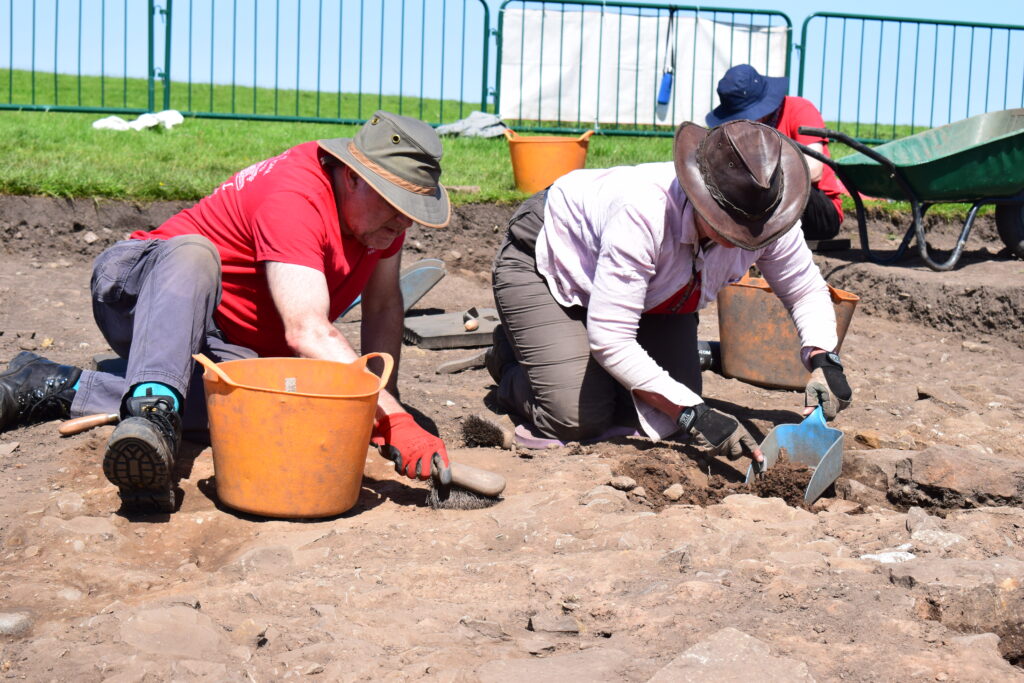
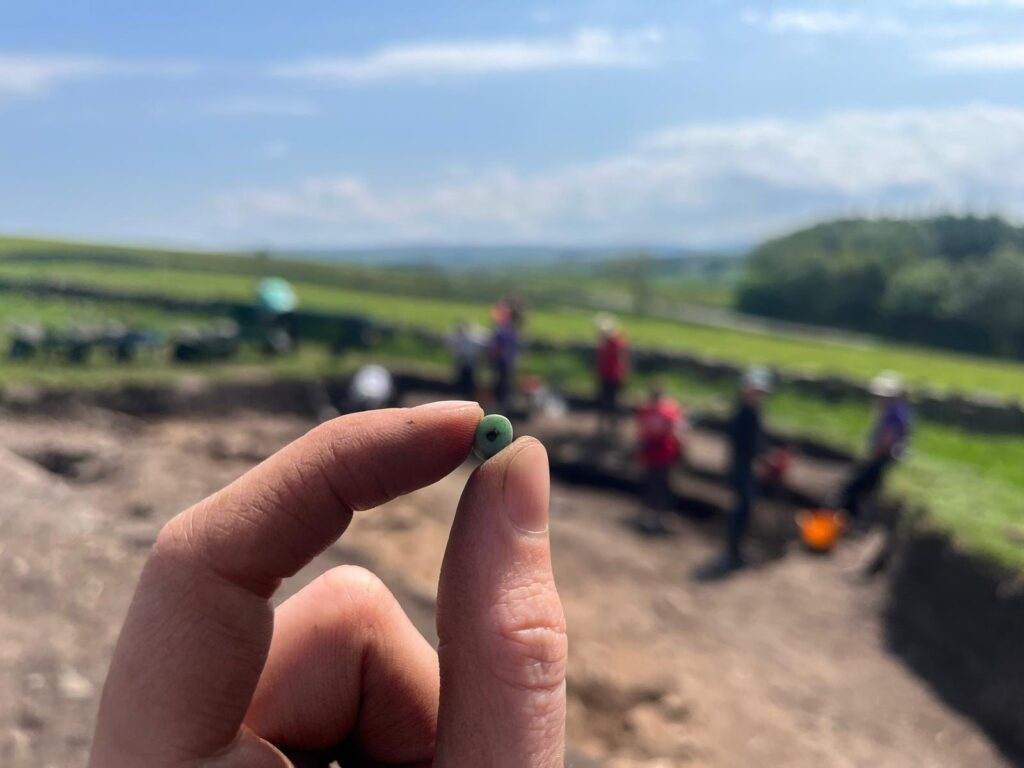
In the southern area everyone has put in a valiant effort clearing the hillwash which overlies the archaeology, particularly given the sweltering conditions we have had this week. The dramatic slope of the landscape is now much clearer, along with the north edge of the ditch. A few nice finds such as a green glass bead and part of a bone pin have given us a hint of what might be waiting once we get into the ditch fill, as well as hopes for more anaerobic layers organic finds. Outside the ditch we have continued working on the outer fort walls, this week concentrating more on the later fort where it junctions with the latrines excavated last year. We have now exposed both the inside and outside face of the wall as it curves round to the south, with at least two courses visible for now. Intriguingly, a bonus section of wall has also been revealed, built up against the inside face of the fort wall. We shall have to wait until next period to see what this is linked to, as always Magna is giving us new surprises to add to its story.
Things have been progressing nicely inside the praetorium as well, though not necessarily according to plan. Once again the post-Roman remains have proven to be far more extensive than we anticipated, forming a large clay and sandstone spread across most of the northern area. We have some earlier walls poking through this, including a long section running N-S, telling us that the Roman layers do survive beneath this and will hopefully be more intact than anticipated! Back in the southern range of the building, we have started demolishing some of the post-Roman walls and insertions, revealing more of the hypocaust system that would have heated the baths for the commanding officer and his family. Its been great to continue reconstructing the layout of this space and getting into intact Roman layers that had been protected by the later material. Rachel